Blog
A Double Sacrifice Zone: Toxic and Carceral Sacrifice on the Road to Delaney Hall
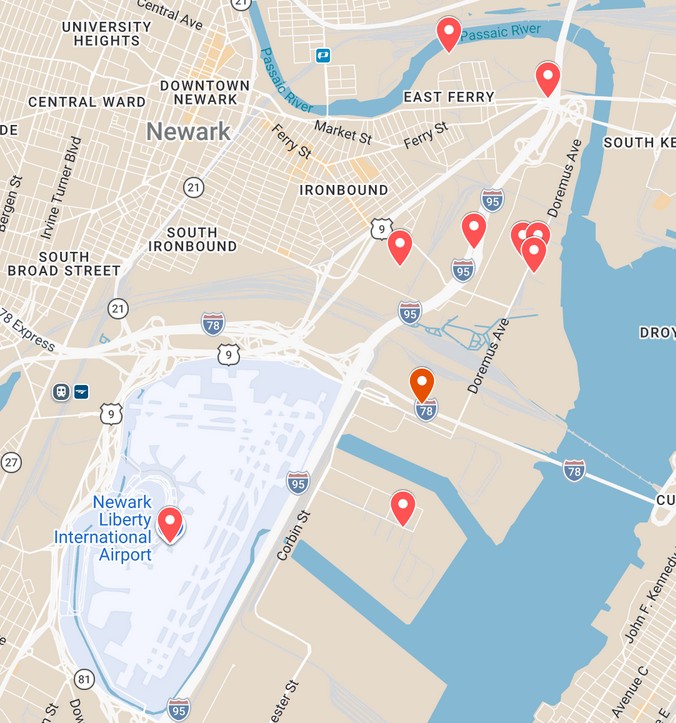
Caption: Interactive map of the Ironbound highlighting key pieces of infrastructure.
Delaney Hall is an ICE facility located within the Ironbound, a historical working-class immigrant neighborhood in Newark, NJ. Since industrialization in the 19th century, the Ironbound has been home to a wide variety of ethnic groups from Germans and Irish in the 1930s, to Brazilians and Ecuadorians in the 1990s and dozens of groups in between, including Portuguese, Spanish, Italian, Lithuanian, Polish, and African Americans. Regardless of ethnic difference, it has been a neighborhood of working-class people, drawn by industrial employment. Its location near natural and built resources, including the Passaic River, Morris Canal, railroads, and Newark Meadows, meant the area quickly filled with factories, as landowners and elites harnessed natural resources for profits. These factories employed the nearby immigrants, providing a livelihood, however, they also had environmental consequences. Odors and smoke bothered residents as early as the 19th century, and workers faced industrial accidents and diseases. Workers and residents also faced health consequences. As Charlotte Leib writes, “Ironbound has long...[exhibited] some of the highest rates of cardiovascular disease, cancer and asthma in the United States.”[1]
Doremus Avenue, the site of Delaney Hall, was historically situated in what was the Newark Meadows, an area which developed later than other parts of the Ironbound. A 1916 headline “Amazing "Growth on the Newark Marsh,” applauded the recent development of Doremus Avenue, a street full of chemical factories, as “one of the most important industrial thoroughfares in the world” and “chemical row.”[2] A chemical and oil company, Balbach Smelting Company and Sun Oil Co, settled across from what is now Delaney Hall (436 and 500 Doremus Ave). The industry on Doremus Ave.—"an investment of nearly twenty million dollars giving employment to some three thousand men”—was profitable for the Ironbound but there were consequences.[3]
Throughout the neighborhood, dense industry led to environmental, health and safety consequences which, on Doremus Avenue, were fatal for workers and residents. Between 1916 and 1971, there were at least seven deaths in fires and explosions in five incidents. Many of the dead and injured were Black and immigrant workers. There were also at least nine more non-fatal fires and explosions, including a giant 1951 explosion where the Newark Evening News reported “Ironbound Thought A-Bomb Had Hit.” The nearby Passaic River became severely polluted. Additionally, residents complained about, “unwholesome, unsanitary, and unhealthful conditions created by the presence of smoke, soot and obnoxious odors” as well as high disease rates.[4]
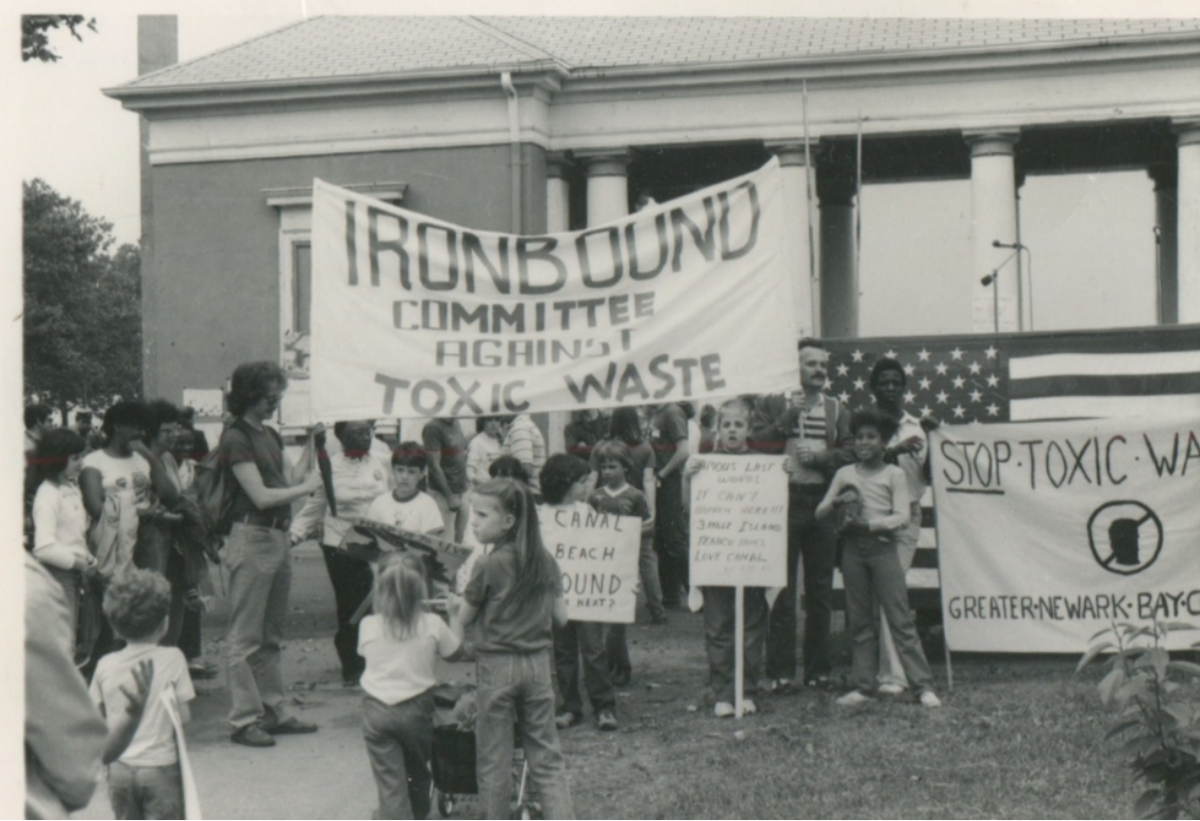
In the 1970s, as the environmental movement spread across the country, activists in Newark associated with Ironbound Community Corporation, began focusing on environmental threats, eventually founding the Ironbound Committee Against Toxic Waste in 1981.[5] Like earlier residents, these residents and activists worried about worker safety as well as odors and fumes impacting the health and safety of residents throughout the neighborhood, especially after yet another factory explosion in 1982, which killed one worker, the 1983 discovery of deadly dioxin on nearby Lister Avenue, and an explosion which killed a truck driver in 1983. They also worried about birth defects, cancers and heart disease, which experts said could be consequences of dioxin and other chemicals. This group protested at least 3 more proposals on Doremus Avenue: a landfill, a toxic waste storage site and an incinerator. Protests such as planting flowers on the land of the Passaic Valley Sewage incinerator led to arrests of activists, but they were eventually successful, with plans for all three proposals being stopped.
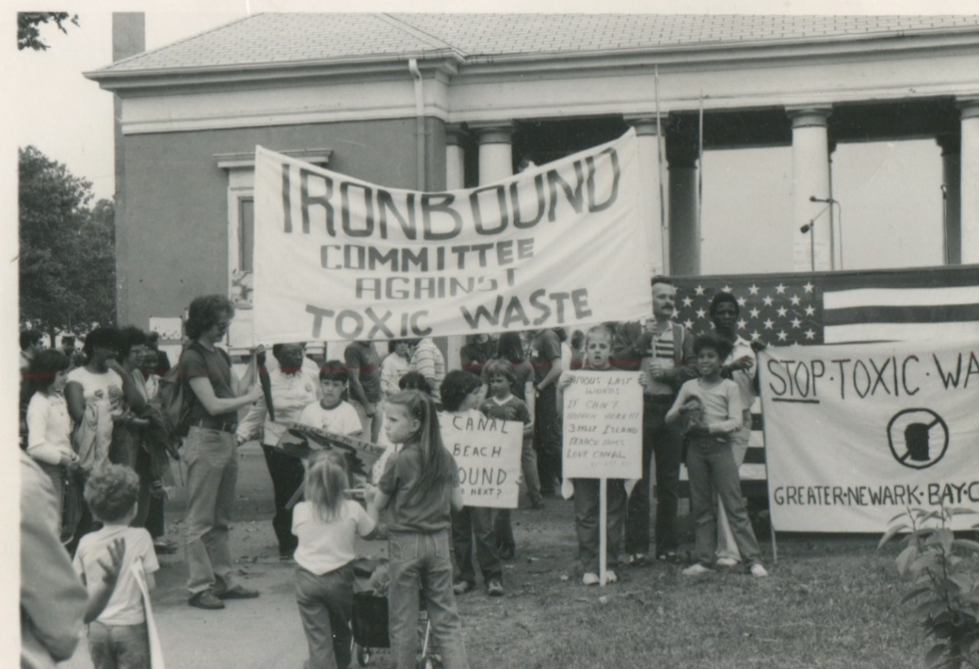
Figure 2 Photo of protest in 1983 against an incinerator in the Ironbound. Credit: Picturing Justice, https://picturingjustice.tumblr.com/tagged/at%20sea%20incineration.
Though activism halted further projects, a century of industry had left Doremus Ave extremely polluted. Almost every site on Doremus Avenue is a site of concern for the Department of Environmental Protection, including the two sites across from the current Delaney Hall (the former Balbach and Sun Oil Co 436 and 500 Doremus). The EPA also declared a high priority superfund site at nearby Lister Ave in 1984 and added another superfund site as of 2014. Despite the known environmental danger, the area continued to be developed in the 1980s. 451 Doremus Avenue, the current site of Delaney Hall, was owned by TMZ Urban Renewal Corp, and they proposed and built a $2.8 million truck terminal on the site. Through the 1990s, though, the truck terminal appeared to struggle, with changes in ownership and an eventual Sherriff’s Sale, devaluing further the already polluted land.
Meanwhile, Essex County was looking to build both a jail and a new drug treatment center: Delaney Hall. Throughout the 1980s in Newark, and throughout the country, there was opposition to halfway houses, drug treatment centers, and jails in residential neighborhoods.[6] The inmates were seen as undesirable and dangerous, and residents worried it would affect taxes and home values.[7] So, the city looked at Doremus Ave, land devalued through pollution and foreclosure, despite knowing about the environmental concerns. Delaney Hall opened in 2000.[8]
Scholars describe the Ironbound as a “sacrifice zone,” where environmental hazards are built in areas with low-income, non-White residents, what historian Ruth Gilmore argues is a geography of racial capitalism, with “unwanted land uses” affecting “working people of all kinds,” in areas that are devalued.[9] Researching in the South, scholar Shuntavia James writes, racial capitalism creates “a moral geography in which certain landscapes are coded as disposable, deemed suitable for toxic industries and human warehousing alike.”[10] I argue that Doremus Avenue, in the East of the Ironbound, is this type of landscape: a double sacrifice zone. Immigrant and Black workers were sacrificed to fires and explosions. The health and safety of nearby residents was sacrificed to fumes, odors, and smoke. Ultimately, when the Delaney Hall treatment center opened in 2000, they too were sacrificed to this environmentally hazardous area. They weren’t the last. Despite environmental complaints by the prison guard union in 2003, jail plans continued, and both prisoners and guards also ended up in this environmentally hazardous section of Newark.[11] As time went on, ICE detainees were also sent to Delaney Hall, and they too have been sacrificed.
Today the Ironbound is still an immigrant neighborhood, with new immigrant groups from Latin America and Africa beginning to settle there. It is still a working-class neighborhood with residents who work in factories and warehouses. Residents still have the same environmental concerns as they did back in the 19th century: health, safety and fumes. One in four children have asthma and new proposals for the area are still being fought. Without activism, there would be even more dangerous and polluting sites on Doremus. Yet, for many years workers, residents, and inmates have been sacrificed to an area that for a century has been environmentally hazardous, dangerous and sometimes even fatal. Today when detainees and their families visit Delaney Hall, 451 Doremus Avenue, they, too, are sacrificed, unknowingly navigating an area with centuries of pollutants and hazards. This history of sacrifice—both environmentally and to the carceral system—makes Delaney Hall, and its surrounding neighborhood a double sacrifice zone for “toxic industries and human warehousing alike.”
Timeline: LINK (Timeline sources are below, and also directly linked when possible).
[1] Charlotte Leib, “Parks Planning and the Quest for Justice in Newark’s Sacrifice Zone” in New Jersey's Natures: Environmental Histories of the Garden State, United States: Rutgers University Press, 2026.
[2] “Amazing Growth on Newark Marsh”, Newark Sunday Call, Jun 18, 1916. Note that Doremus was previously Avenue R.
[3] ”Amazing Growth”
[4] “For Expansion of Smoke Unit,” Newark Evening News Dec 16, 1948.
[5] Ana Isabel Baptista, “Environmental Justice Tours: Transformative Narratives of Struggle, Solidarity, and Activism”, in Toxic Heritage, edited by Elizabeth Kryder-Reid (Taylor & Francis Group, 2023): 356-359.
[6] Carl Shapiro, Letter, Star Ledger, Dec 23, 1987; Frederick Byrd, “Newark airs opposition to prison halfway house” Star Ledger Dec 23, 1987.
[7] E.g. we can see in Diane Walsh, Diane Walsh, “Freeholders, Newark council clear Ironbound sportsplex, Star Ledger, Oct 17, 1996., freeholder Joe Parvellechio links incinerators and halfway houses, both as undesirable for the neighborhood; Barbara Kukla, ”City Passes Measure Mandating AIDS test” Star Ledger, Jan 11, 1988.
[8] William Kleinknecht, “Ex Warehouse Opens in Newark as Inmate Drug Treament Center.” Star Ledger.May 3, 2000.
[9] Baptista, Ana, “Environmental Justice Tours”; Gilmore, Golden Gulag, 188-191.
[10] Shuntavia N. James, “Carceral Bioethics of Place: Environmental Punishment and Justice in the U.S. South,” Journal of healthcare, science and the humanities vol. 15,1 (2025): 26-36.
[11] Nikita Stewart, “A fear for what might lie below shadows jail project,” Star Ledger, Sept 7, 2003. Nikita Stewart, Nikita Stewart, “It’s Moving Time for New Jails Prisoners,” Star Ledger, Mar 26 2004.