Blog
Corporate Transparency as a Tool: Pinpointing Weaknesses in GEO Group’s Structure and Strategy
As one investor newsletter bluntly put it, GEO Group, the largest private prison corporation in the US, is the “default play” on immigration enforcement.[1] Over four decades, the company has actively reshaped itself to adapt to changing political climates. Each transformation was made with the intent to maximize shareholder returns regardless of the results of elections and who sits in the White House or what local communities want. Understanding GEO’s corporate history may help activists orient strategic goals to fight detention.
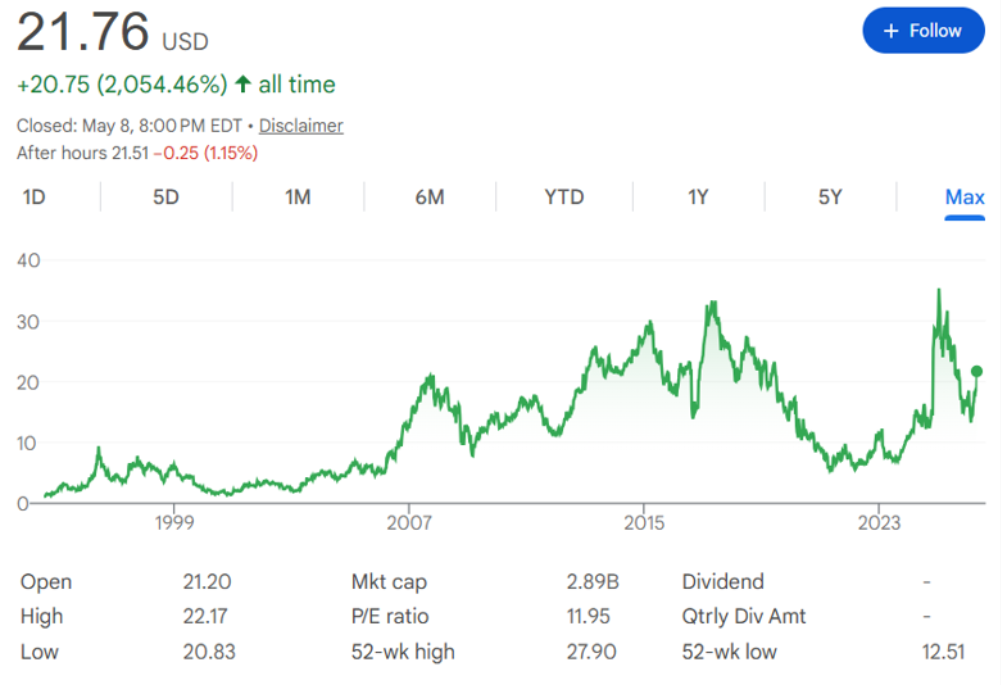
Caption: GEO has generated a 2,054.46% return over its history of being publicly traded. These are the returns on human suffering.
I trace GEO’s history in three strategic phases: first, the company’s origins in the 1980s, second, the REIT era, when it legally obligated itself to return 90% of income to shareholders, creating a structural demand for full facilities; and third, the current period, marked by intense political lobbying and a retreat from REIT status to manage crushing debt. The paper concludes by turning these findings into actionable information for organizers.
This essay relies primarily on sources that come from corporate media and the company itself: corporate documents, SEC filings, investor newsletters, press releases, and business databases. These sources are produced by and for the industry, revealing strategies that the company would otherwise keep from public view. Unlike mainstream news coverage, corporate sources expose the underlying logic: profit margins, debt structures, REIT conversion tactics, and the explicit language of “unprecedented opportunities” for mass deportation.[2] Reading corporate press releases against the grain and treating them as confessions of intent rather than public relations uncovers truths about GEO Group that are otherwise obscure: that detention is a real estate play, that political contributions buy contracts, and that shareholder returns always come before human welfare.
Phase 1: Origins of GEO
In 1951, George Wackenhut joined the FBI, absorbing the Bureau’s rigid anti‑communist ideology and its conviction that surveillance and control were proper responses to social disorder. As the prison population exploded in the late 1970s and early 1980s, Wackenhut saw an opportunity. In 1984, the company established a corrections division, and in 1986 it won its first contract: to construct a facility in Colorado for the INS, the precursor to today’s ICE. Expanding into new markets required political access campaign contributions used heavily by Community Education Centers (CEC) which would later lead GEO to Newark. [3][4]
Phase 2: Financialization – The REIT Era (2011–2020)
On January 1, 2013, GEO converted to a REIT, which must distribute at least 90% of its taxable income to shareholders annually. In exchange, it pays no federal corporate income tax. This made keeping detention beds full a legal requirement. Empty beds meant lower income, smaller dividends, and unhappy shareholders.[5] The REIT era made GEO’s stock highly sensitive to politics. When Trump was elected in 2016, GEO’s stock surged. When Biden signaled a shift away from private prisons, the stock tumbled. By 2020, activist pressure pushed GEO to the brink. Banks began pulling financing. In December 2021, GEO abandoned REIT status, taking a $70 million tax charge and seeing its stock fall 15% in a single day.
Phase 3: Political Adaptation (2016–Present)
After Trump’s election, GEO founder George Zoley called it an “unprecedented opportunity” to “scale up” detention. The company made over $500,000 in political contributions to Trump‑aligned groups. While GEO and CoreCivic compete for individual contracts, they cooperate when facing state‑level bans. The private prison industry operates less like a competitive market and more like a cooperative oligopoly
Actionable Leverage: Turning Corporate History into Organizing Strategy
Today, GEO still carries massive long‑term debt and pays over $160 million annually in interest. High‑leverage campaigns can exploit this by supporting local lawsuits (like Newark’s certificate of occupancy challenge), pressuring banks and pension funds to divest, and demanding public disclosure of debt covenants. Every legal fight, every regulatory fine, every delay in contract renewal imposes real costs that GEO cannot easily absorb. This financial fragility is a target to be exploited.
It is important to note that GEO does not act alone. This paper reveals a tacit cooperation with CoreCivic: CoreCivic’s successful challenge to New Jersey’s ban directly enabled GEO to operate Delaney Hall, while GEO’s victory in the Newsom case in California benefited CoreCivic nationwide. Organizers can expose this cooperation to undermine the industry’s claim to be a competitive market and using an inverse logic that a harm to one company’s profitability will harm the industry as a whole. Locally, the same political contributions that bought access to Essex County Executive Joseph DiVincenzo Jr. explain why officials support detention despite community opposition. Campaigns can demand ethics reforms, force disclosure of campaign donations, and pressure secondary contractors’ subcontractors, which supplies meals to Delaney Hall.
Pension Funds, 401(k)s, and the ETF Problem
For many working people, their retirement savings are not directly invested in individual stocks like GEO Group. Instead, their money sits in index funds and ETFs bundles of stocks that track broad market indexes like the Russell 2000 or S&P Small-Cap 600. Because GEO is included in those indexes, any 401(k) or pension plan that invests in a passive index fund that tracks those benchmarks is inadvertently holding GEO shares. BlackRock is the largest institutional shareholder of GEO, holding 15.64% of the company's shares, and its iShares Core S&P Small-Cap ETF has 6.19% of its assets in GEO Group stock. The Vanguard Group is another top holder, owning 11.22% of GEO. Crucially, both BlackRock and Vanguard are also the two largest holders of CoreCivic, meaning that many standard retirement funds contain both companies.
This creates a hidden vulnerability for GEO. When pension funds and 401(k) plans hold GEO stock indirectly, they are providing the company with a stable base of institutional investment. But that stability can become a liability if activists convince those funds to divest. There is already a track record of success: after reviewing their heinous track record of human rights abuses, the California Public Employees' Retirement System (CalPERS) divested from both GEO Group and CoreCivic. Decreasing share price raises the cost of financing should the company wish to raise capital through equity offering that involve the selling of company shares.
For community organizers, this is a direct pressure point. Workers can ask their union pension fund managers as well as 401K managers: Does our retirement money profit from immigrant detention? They can demand that fund managers switch to socially responsible investment funds that explicitly screen out private prison companies. And they can point to successful precedents like California, where divestment occurred on humanitarian grounds. If enough union members and public employees demand that their pensions divest from GEO, the company loses a stable source of institutional investment and gains a powerful financial headache.
[1] Citron Research, "Geo Group 2024 Q2." Newstex, 2025
[2] Shirso Dasgupta, "Florida’s Geo Group Plays Central Role in Trump’s Mass Deportation Plan." Miami Herald. (October 5, 2025 2025).
[3] MuckRock, "From Fbi Reject to Private Warlord: The Rise of George Wackenhut.", 2017
[4] Karina Wilkinson, Kathy O’Leary, Frank Smith. “Essex County Immigration Detention Expansion, an Invitation for Abuse.” (Middlesex County Coalition for Immigrant Rights, 2011) 14-18
[5] Advocacy, U.S. Securities and Exchange Commission. Office of Investor Education and. Investor Bulletin: Real Estate Investment Trusts (Reits): U.S. Securities and Exchange Commission.