Blog
“There are many things that can only be seen through eyes that have cried”: Gendered Subjectivities inside Delaney Hall
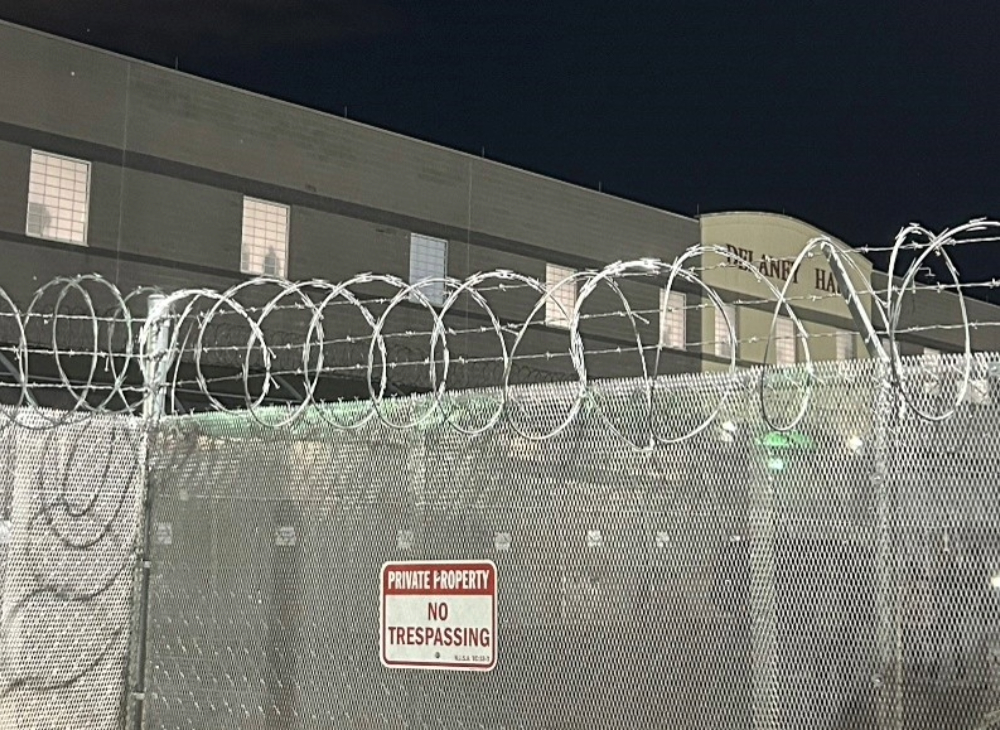
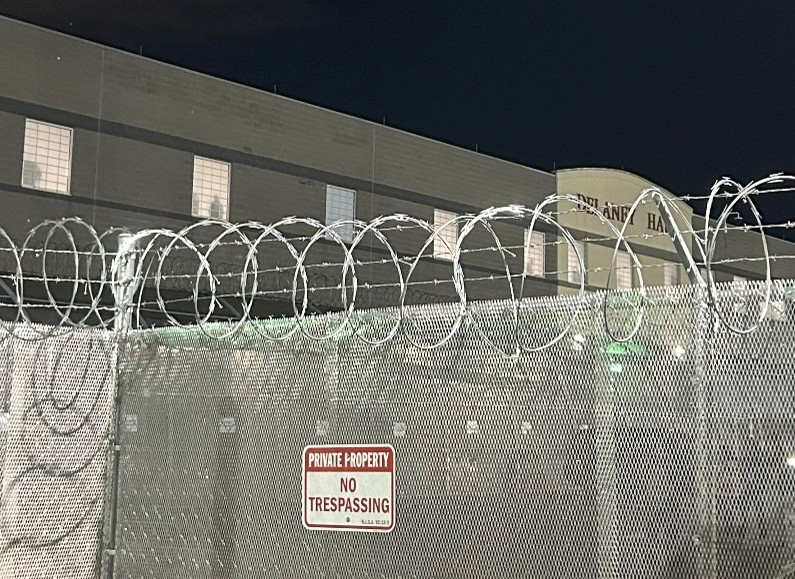
Caption: Faint silhouettes behind frosted windows, high fences and barbed wire at Delaney Hall. Photo by Isabel Muniz Medina
Beyond materializing confinement as a punitive response for migration, the 2025 reopening of Delaney Hall—the largest immigration detention center on the East Coast—also brings renewed attention to the harsh conditions detained individuals are subjected to. Back in June 2025 a released detainee spoke to ABC News about conditions inside Delaney Hall, stating that “he doesn’t know how to describe it because he hasn’t seen animals treated this way.” GEO Group defends the facility it owns by emphasizing capacity and logistics. Its critics point to something harder to quantify: the slow erosion of human rights and dignity that occurs when confinement is arbitrary and oversight denied.
Experiences inside immigration detention are not a monolith, however. Within the overarching made-for-profit detrimental conditions, there are multiple layers of subjectivities and vulnerabilities also woven into the system. Detention operates as a deeply gendered and heteronormative system that differentially shapes the experiences of those it confines and those visiting, creating particular ways in which gender and sexuality are regulated, erased, or disciplined. Delaney Hall not merely fails to accommodate gender diversity but actively reproduces structures of victimization through both practice and policy.
The current administration’s war on gender diversity has exacerbated the harms that women and the queer population face inside detention. Trump has directed that transgender individuals must be held in units according to their biological sex. ICE National Detention Standards (NDS) were revised in 2025 to “align with the Executive Order [of] ‘Defending Women from Gender Ideology Extremism and Restoring Biological Truth to The Federal Government,’” replacing references of gender with sex throughout the document. Additionally, the revisions eliminated the section dedicated specifically to women’s health care, collapsing it into the general Medical Care section.
Broadly, administrative language obscures and delegitimizes specific gender-based vulnerabilities, often rendering queer individuals invisible or improperly classified. GEO Group does not have policies that address the specific needs of women or queer detainees, nor does it outline protections against discrimination affecting individuals in these groups. Its non-discrimination disclosure applies solely to dynamics between employees and focuses on maintaining a “workplace that is free from discrimination and harassment.” Following Trump’s crackdown on transgender rights, ICE removed its 2015 “Transgender Care Memorandum” from its website and proceeded to omit and erase transgender detainees’ data from their reports.
Similarly, visitors must also comply with the system’s normalized assumptions about morality, sexuality, vulnerability, and control. Clothing requirements show an intensified sexualization and regulation of women’s bodies. At Delaney Hall, female visitors are subject to ten clothing restrictions, compared to only three for male visitors. Prohibitions codified in tight or sheer clothing, pants with holes, or required clothing “over customarily covered areas of the anatomy” result in female visitors being more frequently turned away for perceived failure to meet these standards. Mutual aid efforts by activists offer some relief by providing clothing to those denied entry, but they also underscore the burden placed on visitors. People must change their clothes outdoors, sometimes in harsh winter conditions without adequate protection. Conversely, in hot weather, the same restrictions require women to remain heavily covered, leading to additional discomfort while waiting in the hot temperatures inside.
An ICE spokesperson stated that this norm is applied strictly to protect visitors. However, the correlation between safety and clothing is never clearly articulated. Visitors are also turned away for failing to comply with unspecified or inconsistently enforced rules, such as shoe type or colors they’re wearing. I have seen individuals denied entry for clothing that, on other occasions, visitors wore without issue. This stands in contradiction with ICE’s statement about safety and instead reflects the arbitrariness of the policy and guards’ subjective, moment-to-moment discretion in determining who is permitted to enter.
David’s Testimonio
The administrative heteronormative dynamics inside the facility are even more complex. The testimony of David (name changed)—a detained individual situated at the intersection of legal status, nationality and queerness—accounts how detention is lived and navigated within these boundaries. David walked the long road from South America to the United States knowing no English and with the heavy burden of the debt from the journey. After coming out as queer, support from his family withered away and his mother stopped speaking to him for a time. In the United States, however, he built a life and found both a partner and a sense of belonging. When he was detained and his visa application was denied, he faced an impossible choice: accept la voluntaria—voluntary departure—or remain in detention while appealing the court’s decision. With his partner and sole support system rooted here, he chose to stay and fight his case. He has been held at Delaney Hall since October 2025.
As a non-English speaking queer individual, David’s experience foregrounds how multiple identity markers and the structures of detention converge to produce distinct forms of vulnerability and marginalization. Scholarship on the effects of the intersectional experience of detention is sparse, particularly as it pertains to gender-based violence. This gap is significant given that many detainees already arrive with histories of gender-based or sexuality-based violence. As a survivor of sexual violence himself, David has been forced to navigate the constant triggers and stressors embedded in his everyday life inside Delaney Hall. Aggressive and invasive pat-downs have been particularly retraumatizing for him, especially in a context where he can’t even appropriately articulate his discomfort. Moreover, this type of surveillance protocol relies on a strict hierarchy, where guards represent uncontestable authority. For survivors already sensitive to power imbalances, the lack of bodily autonomy that pat-downs represent reinforces their original trauma, further complicating their healing process. This and other types of commonplace indignities and invasions of privacy, “can lead to deep feelings of vulnerability, shame, insecurity and dehumanization, significantly affecting mental health.”[1]
While official policy outlines certain measures intended to prevent sexual assault or discomfort, it does so through a heteronormative rationale of sexual conduct that disregards the specific vulnerabilities of queer individuals. The NDS guideline that “[d]etainees shall be able to shower, perform bodily functions, and change clothing without being viewed by staff of the opposite sex” assumes risk only arises from opposite-sex exposure and surveillance. This approach fails to account for individuals who have been victimized by people of the same sex and does not adequately address broader concerns around privacy, even for those who are not survivors of sexual violence. The logic that harm only stems from exposure to the opposite sex disregards the fundamental importance of dignified privacy and consent.
Similarly, open showers, despite restrictions on opposite-sex viewing, requires bodily exposure that can be distressing or even retraumatizing. Testimonies from former detainees underscore these concerns, with females describing how the lack of privacy made even routine acts like using the toilet feel violating.[2] For women, being forced to use open showers and toilet spaces during menstruation represent an added layer of indignity. For sexual violence survivors like David, open showers signify a space that enhances vulnerability and insecurity. ICE policy states that detainees at risk of sexual victimization, “when operationally feasible…shall be given the opportunity to shower separately from other detainees.”[3] This statute, however, is not comprehensively responsive to the mental health and well-being of individuals with previous history of victimization. In short, the conflation of these conditions and dynamics complicates the idea of a homogenous experience within immigration detention systems.
[1] UN Women and International Detention Coalition, “Policy Brief. Experiences and Challenges Faced by Migrant Women Affected by Immigration Detention,” 2025, 4.
[2] “Inside ICE Detention: Stripped, Shackled, Starved,” New York Times Opinion, November 17, 2025, at 1 min, 50 seconds, https://www.youtube.com/watch?v=e4X0hI40a8A.
[3] NDS: Revised 2025, 129.