Blog
From Drug Courts to ICE Detention: The Political Economy of Delaney Hall
In the heat of early afternoon July 2004, federal marshals walked into the concrete building where the words “Delaney Hall” were lettered in red across the façade. Inside, the Immigration and Customs Enforcement agents served Dean Rose, who was serving a 91-day sentence for drug paraphernalia, a federal immigration detainer.[1] For a citizen, the offense could remain a misdemeanor. For a noncitizen, the same drug conviction triggered detention and deportation.
Delaney Hall originally opened its doors in May 2000 as a 732-bed private drug-treatment facility owned by Community Education Centers (CEC), a private detention facility based out of New Jersey.[2] By 2025, the same Doremus Avenue facility housed up to 1,200 people as an immigration detention center, under a 15-year, $1 billion contract between U.S. Immigration and Customs Enforcement (ICE) and GEO Group.[3] Across its shift, crimmigration and privatization have been the lasting foundations of Delaney Hall.
Crimmigration refers to the merger of criminal punishment and immigration enforcement. Under federal laws passed during the War on Drugs, criminal convictions—especially drug convictions—became pathways to detention and deportation for noncitizens. Privatization means that public agencies, like the Department of Corrections or Immigration and Customs Enforcement, outsource confinement to private companies. This effectively centers contract opportunities and portfolio expansion for imprisonment. Delaney Hall sits precisely where these two systems meet, made possible by New Jersey’s own War on Drugs.
The state’s Comprehensive Drug Reform Act of 1987 imposed harsh drug penalties, including mandatory minimum sentences tied to proximity to a school zone. This meant dense cities like Newark and Camden were “all-encompassing drug free zones.”[4] These laws expanded the population under state supervision, predominately Black and Latinx residents. The result was an overcrowded prison population and rising costs, to which the state responded by funneling people to drug courts and halfway houses, or “residential community release” programs, presented as humane alternatives to prison. In practice, they created a lucrative market for private companies to manage people under correctional control.
In New Jersey, CEC dominated this market through legal engineering and political access. To satisfy the state’s requirement that all corrections contracting must be done through nonprofits, CEC created Education Health Centers of America (EHCA), a nominal nonprofit that routed state money back to the for-profit company. A 2011 state comptroller audit found that more than 97% of EHCA’s revenue since 1997 had been routed to CEC.[5]
The political relationships the company maintained were just as deliberate. Future governor Chris Christie and future CEC vice president William Patalucci were partners at the firm that designed the EHCA shell, Dughi and Hewit. CEC and its executives gave more than $370,000 to New Jersey political candidates over the following decade. At the county level, CEC contributed close to $160,000 to Essex County political entities between 1998 and 2010. This includes the $31,000 given to the Essex County Democratic Committee, Essex County Republican Committee, and Joe DiVincenzo in the years 1998 and 1999—the same years Delaney’s first contracts were being negotiated.
From the start, Essex County officials defended Delaney Hall, presenting it as a therapeutic alternative to incarceration. Then-County Director of Corrections Joseph Manzella urged the first contract approval on the grounds that the arrangement would “break the cycle of warehousing people,” but the contract demonstrated the incentive was profit, not rehabilitation.[6] Essex County paid CEC $45–$67 per inmate per day, compared to $90–$97 in the Newark jail.[7] However, the idea of “treatment” was unstable from the start, and the cost of savings for the county and revenue for CEC came at the expense of those confined.
Inside Delaney Hall’s walls, posters read “Be Positive” and “Stop Lying.” Residents were called “clients,” and they performed all of the cleaning, painting, cooking, and physical-plant labor.[8] By 2012, The New York Times reported that Delaney “regularly intermingled people held on low-level charges with inmates who have violent records.”[9] A 2012 state Senate oversight hearing heard that detainees were begging staff, “Please don’t send me to Delaney Hall.”[10]
In May 2009, Derek West Harris, a 47-year-old held on a non-violent charge with a bail under $75,000, was beaten to death by inmates held on violent charges but similarly low bail.[11] Harris and his attackers were placed in Delaney so that Essex County could free beds in its jail to then lease those beds to ICE at a profit.[12] By 2011, CEC charged the county approximately $72 per detainee per day; the county then leased the vacated jail beds to ICE at approximately $108 dollars per detainee per day.[13] The daily spread of $36 per person per day amounted to a significant revenue stream. Between 2009 and 2012, Essex County received more than $77 million from the federal government, with another $200 million projected through 2016.[14] Under this arrangement, public corrections ceased to be a cost center and became a profit center, and Delaney Hall maximized its contractual value with federal immigration detainees.
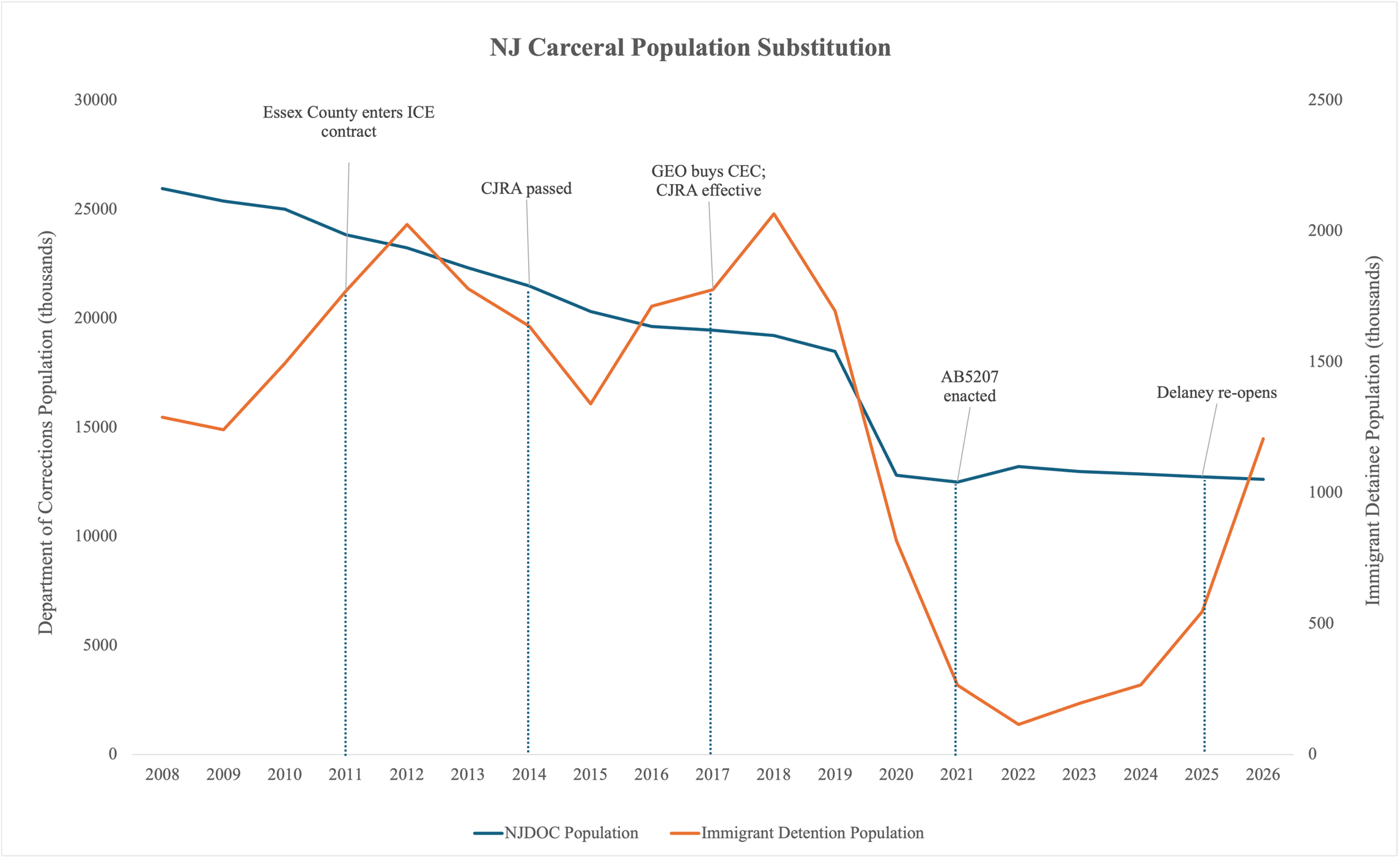
When New Jersey’s Criminal Justice Reform Act took effect in January 2017, largely eliminating cash bail, the pre-trial population that filled Delaney’s beds collapsed. CEC laid off 166 workers, and a company spokesman stated the company's strategy plainly, “We do not plan to close Delaney and are currently seeking new customers.”[15] Weeks later, GEO Group acquired CEC for $360 million in cash, branding the acquisition as part of the diversified "GEO Continuum of Care” portfolio.[16] Within a year, ICE detention in New Jersey hit an all-time peak of 2,066 inmates. The drug court population had been replaced by the immigrant detainee population because it was profitable and growing.
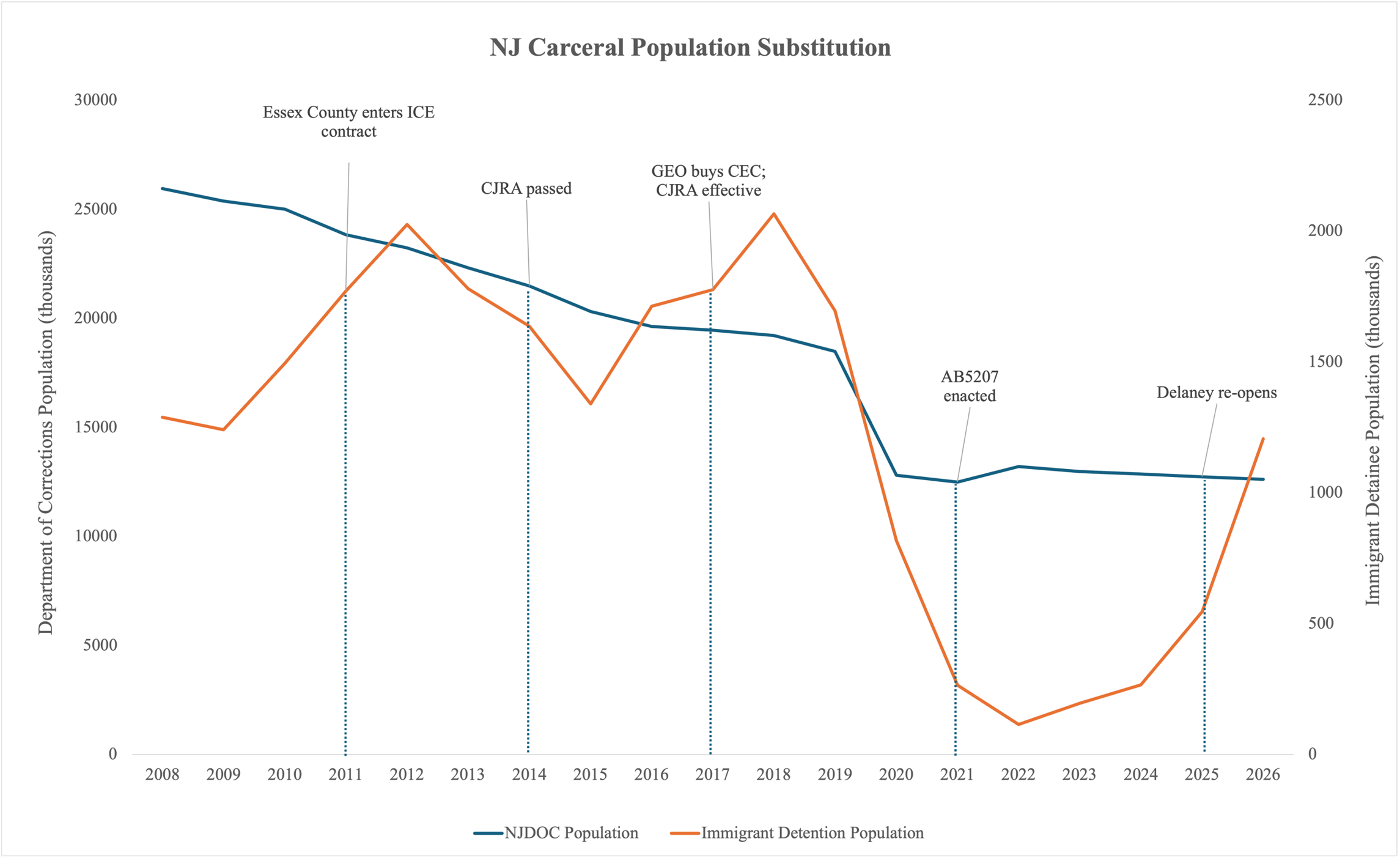
Figure 1 As criminal incarceration decreased in New Jersey, it was replaced by immigration detention. Data analysis by Avery Goodman.
Delaney Hall cannot be reformed. Its shifts are variations on a single governing logic: the production of profit through the warehousing of excluded populations. The private corporations and politicians on its payroll allow Delaney Hall to adapt to policy changes, legal challenges, and market conditions, but its core function remains unchanged. It exists to confine populations deemed expendable and to generate profit from their detention.
[1]Inmate Tries to Flee Halfway House as Marshall Arrive with Detainer,” The Star Ledger (Newark, NJ), July 31, 2004.
[2] William Kleinknecht, “Inmate Drug Center Opens in Newark,” The Star Ledger (Newark, NJ), May 3, 2000.
[3] Gwynne Hogan, “Prison Company Foresees ‘Unprecedented’ Revenue, Announces Massive Newark ICE Lock-Up,” The City (New York, NY), February 27, 2025
[4]Stephen Hunter et al., “New Jersey’s Drug Courts: A Fundamental Shift from the War on Drugs to a Public Health Approach Fro Drug Addiction and Drug-Related Crime,” Rutgers Law Review 64, no. 3 (2012), 803
[5] Matthew Boxer, “State Comptroller Audit Exposes Crucial Weaknesses in State Oversight of Inmate Halfway Houses,” Office of the State Comptroller, June 15, 2011.
[6] “Essex Freeholders Weigh $13 Million Rehab Contract,” Star-Ledger, January 13, 2000.
[7] William Kleinknecht, “Inmate Drug Center Opens in Newark,” The Star Ledger (Newark, NJ), May 3, 2000.
[8] Kimberly Brown, “Treatment Program Escaped Budget Ax,” The Star Ledger (Newark, NJ), July 28, 2002.
[9] Sam Dolnick, “A Penal Unit, A Volatile Mix Fuels a Murder,” New York Times, June 18, 2012.
[10] Halfway House Oversight Committee Hearing: Hearing before the Senate Legislative Oversight Committee (2012), 108
[11] Sam Dolnick, “A Penal Unit, A Volatile Mix Fuels a Murder,” New York Times, June 18, 2012.
[12] Ibid.
[13] Essex County Corrections Officers PBA Local No. 382 v. County of Essex, 439 N.J. Super. 107 (App. Div. 2014), Justia; “Essex County Immigration Detention Expansion, an Invitation for Abuse,” Prison Legal News, 2012
[14]Sam Dolnick, “As Escapees Stream Out, a Penal Business Thrives,” New York Times, June 16, 2012.
[15] Jessica Mazzola, “Low Prisoner Population Prompts Re-Entry Program Job Reductions,” The Star Ledger (Newark, NJ), April 9, 2017.
[16] “The GEO Group Acquires Community Education Centers,” GEO World 23, no. 2 (2nd Quarter 2017): 2–3.