Blog
Resistance Company: Evolutions in Opposition at Delaney Hall
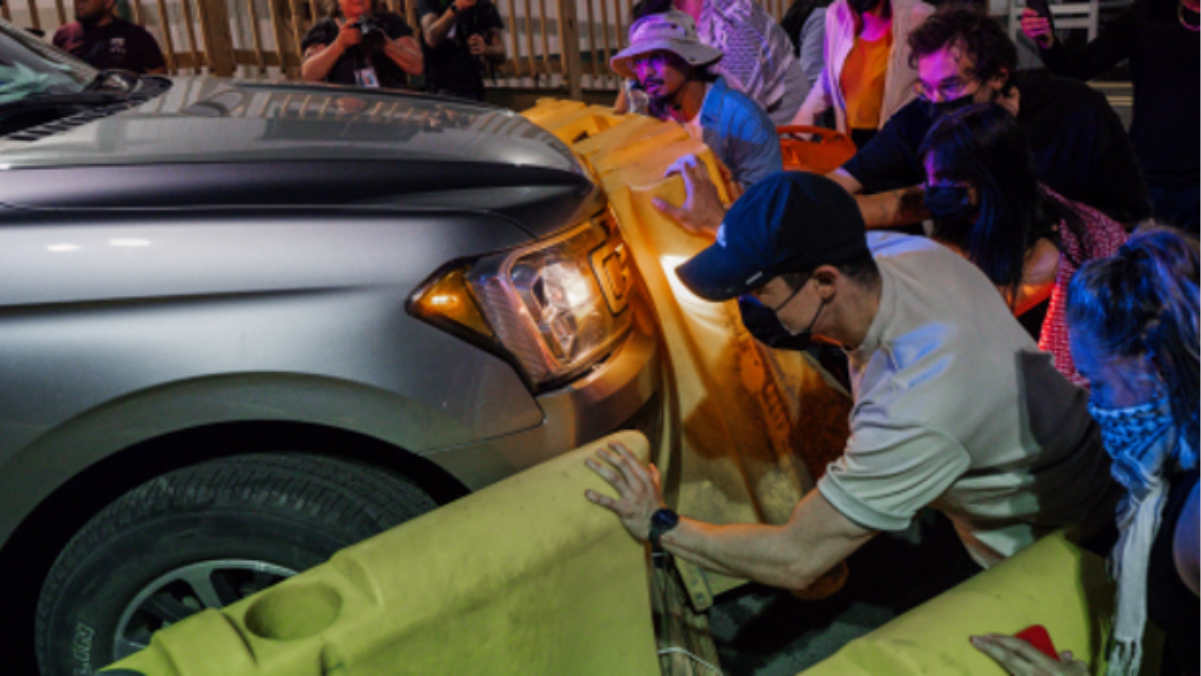
Figure 1 Protestors at Delaney Hall on June 12 trying to prevent a vehicle from exiting the facility.
On any given day close to 1,000 detainees in Newark’s toxic corridor await court proceedings, transfers, or a chance at voluntary departure from a “hulking fortress.” On the outside, however, “sustained community opposition” is how groups like the ACLU, describe the organized effort to resist the occupation of the corporate jailor, GEO Group, the private detention company running Delaney Hall.
Resistance has manifested in different ways throughout the past year, from legal and legislative efforts to direct confrontation blurring the lines of nonviolent action, to finally harm reduction for the detainees inside (this was written before the hunger and labor strike called by detainees in late May 2026 led to violent ICE and police response). A patchwork of resisters from clergy, politicians, activists, organizers, labor unions, and ordinary neighbors make up the everyday struggle outside the gates of Delaney.
Legal and Legislative Efforts
With more executive orders than any president before, Trump 2.0. added $45 billion into the coffers for building new detention centers. The first detention center in Trump’s second term would be Delaney Hall.
In August 2024, Newark City Hall learned that construction had begun inside Delaney Hall. “We started prepping them for what the federal contracting process looked like,” said Amy Torres, Executive Director of New Jersey Alliance for Immigrant Justice.[1] Torres noted that construction had commenced before the information solicitation period—a formal step in the process ICE undertakes to award contracts to contractors.
On February 25, 2025, ICE announced the reopening of Delaney Hall. Two days later Newark Mayor Ras. J Baraka released a statement reiterating that “Without satisfying city property-use requirements, inspections, and permits, Delaney Hall cannot lawfully open at this time.” Two weeks later, advocates from the ACLU, First Friends of New Jersey New York, the New Jersey Alliance for Immigrant Justice, and Faith in NJ staged a rally outside Delaney.
On March 11, 2025 over a hundred advocates, including some labor unions like 32BJ SEIU joined Mayor Baraka at the gates of Delaney to denounce plans by the administration to quadruple New Jersey’s detention capacity. On April 1, Newark filed a complaint in Essex County Superior Court against GEO Group demanding the city be let into the facility after being barred entry a day before, and after numerous attempts to enter. The complaint alleged GEO Group had been performing illegal construction and demanded it cease occupancy.
This first stage of resistance was legislative, legalistic, and mostly composed of non-profit groups sounding the alarm at Delaney while organizing statewide for protections against ICE. The next stage in the evolution of opposition would provide more direct confrontations with the machine.
Confrontation
On May 6, Baraka attempted another site visit, joined by dozens of advocates from organizations like Movimiento Cosecha. An Instagram post documented the city’s failed attempts to issue citations, capturing a photo of a citation from the fire department lying wet on the ground near the entrance. Legal measures were yielding little results. On May 9, Baraka visited again, this time with three of New Jersey’s congressional delegation, Representatives LaMonica McIver, Bonnie Watson Coleman, and Rob Menendez Jr.
Charlene Walker, Executive Director of Faith in New Jersey, a network of clergy organizing their congregations around immigration and other issues, shared her firsthand perspective of the event:
I remember standing by the fence with a group of people and hearing someone say ‘He’s here. We’re going to arrest him now.’ And out of nowhere it looked almost as though it was a football play…some of us got pushed, myself included, in order to get to the Mayor.[2]
The Mayor was arrested, despite leaving the property line, and detained for a few hours at a nearby DHS field office.
Three days later, Faith in New Jersey convened faith leaders at Delaney to block the entrance, poised in prayer and song. Activists lasted six hours until ICE agents pushed the faith leaders’ arm-in-arm blockade of the driveway, at which point Newark Police officers stepped in in front of the blockade. Arrests were made. “I was thrown to the ground because I was trying to de-arrest” a protestor targeted by ICE, said Carissa Cunningham, member of Democratic Socialists of America.[3]
On Friday, June 12, Delaney reached its highest population yet with 974 detainees inside. Reports had gotten to advocates of meals being divided up among detainees, with extended periods in between. According to an immigration lawyer, as many as 50 detainees pushed down a wall inside the dormitory room in protest. Four men self-emancipated from the jail Friday morning, and some reported that they had punched through an exterior wall. GEO Group used vans to transport detainees and bring in more agents, leaving immigration lawyers with clients inside barred from entering. Later that evening advocates reported that around 6PM a loud popping noise was heard coming from the facility followed by a gas that made visitors waiting in line cough. Federal agents swarmed the facility that evening, some wearing gas masks.
“That was my first day at Delaney. It was actually my third week in New Jersey at that point,” recounted Desmond Kuhn, a student from Columbia University who made the trek to Delaney to support visitors after being invited by Cunningham. Desmond’s first encounter with Delaney would be during its most tumultuous weekend yet. “As it started getting darker out there were more radical people…people willing to risk some things…by the time the sun set that’s when people started blocking vans.”[4] Kuhn and Cunningham “buddied up” that evening, witnessing direct confrontations between protestors and ICE agents and their vehicles transporting detainees out of Delaney.
A two-hour long stream from the night showed agents throwing protestors to the ground, unsheathing batons, and struggling over orange road barriers used by protestors to block vehicles from entering and exiting the gates. “I’m very proud of what we did,” Kuhn shared. Over 100 detainees were transferred out on June 12th.
This level of resistance at Delaney would be remembered as the weekend Delaney fought back; when the community rose up and traded previously nonviolent action for confrontational direct action. In the year since the uprising, more and more detainee families were left without answers at the gates, wondering whether a family member had been transferred hundreds of miles away.
Harm Reduction
Eyes on ICE, a coalition made up of members of organizations including SOMA Action, Pax Christi NJ, Action 21, First Friends of NJ/NY, and Resistencia En Accion, recognized the difficulties faced by visitors to the facility, from lack of bathrooms to arbitrary visitation times to economic repercussions of lost income. It responded by soliciting donations for bags of food, Uber and ShopRite gift cards, and toys to comfort children.
By fall, visiting hours expanded from two days a week to four. With that, came the expansion and formalization of the Eyes on ICE coalition as well as new demands for indoor shelter for families waiting to visit loved ones. Desmond continued to show up to Eyes On ICE distributions on Saturdays, assisting with clothing distribution as often visitors would be turned away if they hadn’t complied with a strict dress code.
[We get] information from families about how their loved one is doing, and what conditions are like inside, and check up on how they are feeling too…Something I had been doing since the start of the semester…is I update the sheet.
Desmond referred me to a volunteer-run spreadsheet of commissary donations organizers had kept updated, providing detainees an occasional snack or beverage. Desmond also visited detainees, some being other university students, providing emotional, and logistical support, checking in with their personal and legal needs. A campus organization Desmond joined, Columbia-Barnard Young Democratic Socialists of America, launched a letter writing campaign for detainees, and sent over 70 letters to Delaney Hall.
Onward
ICE further expanded into communities across New Jersey in 2026. The deaths of Renee Nicole Good and Alex Pretti early in the year also sent shockwaves throughout the U.S including in Newark and Jersey City where protests continued. Meanwhile, as Delaney’s population increased and visitation hours expanded, there became a need and an opportunity to maintain and strengthen ties to the outside for detainees.
Amy Torres noted the different roles actors play within the movement, when discussing whether there is a reason tactics have shifted:
Eyes On ICE has been such an incredible community effort over the last year…folks on the ground have talked with community, they’re listening to community and they’re providing. The role of advocacy organizations [like NJAIJ] is to be the one raising the alarm and putting that alarm in as many places as we can. There’s always a need for direct services, mutual support on the ground, and there has to be someone who heads up river and stops whoever’s throwing the babies in the river.
Amy, however, admitted she sees much of the direct action around immigrant detention today as cathartic:
We’re living in a very different time today than I think we were in 2017 where the catharsis of protesting and marching and going out is even more transparently catharsis than it’s ever been. What we really need are people funding lawyers, and not spending money on protest supplies but putting that money toward bonds. We need less social media and more camping out at your elected officials house and being a problem for people. It’s good to have community, healing and catharsis but we don’t have a lot of time left. Every moment is an inch ceded to the opposition.
Carissa, on the other hand, still sees the job of closing down Delaney as the primary goal, and believes it’s a goal within reach with the right amount of numbers.
“I still believe that we can shut down Delaney Hall. I believe that we will shut down Delaney Hall. I think we just need 500 more people.”
Whether these differences in strategy amount to anything tangible on the ground at Delaney remains to be seen. A diverse patchwork of actors, groups, and organizers continue to take part in the fight for better policy as well as protest and support for the detained and their families in what I call “resistance company.”
[1] Amy Torres, interviewed by Isaac Jimenez, April 30, 2026.
[2] Charlene Walker, interviewed by Isaac Jimenez, April 27, 2026.
[3] Carissa Cunningham, interviewed by Isaac Jimenez, April 25, 2026.
[4] Desmond Kuhn, interviewed by Isaac Jimenez, April 27, 2026.